Durles
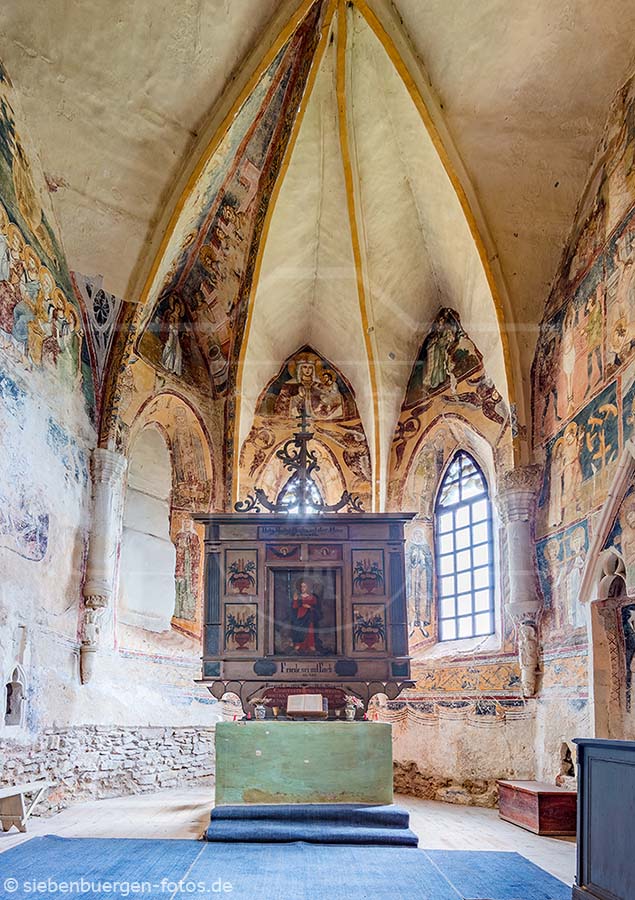
The chancel is covered by a Gothic vault on sturdy wall shafts, two of which bear unusual round sculptures with baldachins, interpreted as the Virgin Mary and the Evangelist John. On the six stone corbels there are figural representations and rosettes. Set into the north wall is a sacrament niche, a Gothic sacristy portal, and a second portal in the Renaissance style.
During recent restoration works, further large-scale wall paintings were uncovered in the chancel. They date from the beginning of the 16th century. The lower section of the wall is surrounded by a painted tapestry — a curtain hanging from rings with gathered folds, as found in many Orthodox church paintings in the Byzantine tradition. The south wall has a tracery-crowned two-seat sedilia, whose background features a wall painting with two holy warriors.
The Byzantine emperor Constantine made Christianity the state religion, elevating it from a persecuted and partially tolerated faith. The wall paintings may well be attributable to a master trained in the Moldavian monasteries, which becomes particularly evident in this depiction of Emperor Constantine. His clothing is more reminiscent of a Moldavian prince.
During restoration works in 1975, severely damaged wall paintings were uncovered between the wall shafts. They show an imaginary curtain decoration. In the 19th century the traveller Auguste de Gerando described the following scenes: the Last Supper, the four Evangelists, martyrs, David, Solomon, Christ, angels, a monk and a devil, and the holy kings Ladislaus and Stephen I of Hungary.
The depiction of Saint Christopher carrying the Christ Child was believed by popular tradition to protect against accidents and sudden death.
On the upper exterior walls of the chancel, fragments of large-scale wall paintings have survived. The south side is covered with scenes of the capture of Jesus and an over-life-size depiction of Christopher. At the chancel head the Crucifixion, Christ before Pilate, and on the north facade the Descent from the Cross and the Entombment are still visible.
The predella is dated 1633. Above it rises a somewhat later section consisting of the central painting — a depiction of the blessing Christ — flanked by side panels depicting flower vases.
Author:
Martin Rill
Date: 03.10.2017
For photos from Durles, please click: Photos from Durles