Bußd bei Mühlbach
Bußd bei Mühlbach (Romanian: Boz, Hungarian: Buzd, Transylvanian Saxon: Buss*) lies in Alba County in Transylvania (Zekesch Highlands), Romania.
It is an old, sleepy village between sunny hills. The former serf village of Unterweißenburg County was first documented — according to varying sources — in 1295 or 1334. The name comes from the Slavic language and means elderberry.
Bußd bei Mühlbach is an example and a perfect model of a balanced understanding and mutual respect for ethnic identities among Romanians, Saxons, Hungarians, and Roma.
The life of the villagers revolved between the large, fertile fields and the Evangelical fortified church. The late-Gothic church houses an enormous bell which, so the story goes, miraculously broke through the black storm clouds and drove away the hail. The children ran barefoot, speaking Saxon and Romanian with each other, but understood each other best through play.
In their remote village — forgotten by the world but not by time — the world wars arrived. The people of Bußd were recruited into the Waffen SS and were forced to fight on the Eastern Front. It is said that on the train taking them to the front they wrote: "Stalin, protect your moustache! The Bußd men are coming!" (Romanian: "Staline, apără-ți mustața! Vin bozenii!"). After the war the Saxons were deported to Russia. Only a few women, children, the sick, and the elderly remained at home. Fewer than half returned, and for those who did come back there was no longer a place for them, as they were considered Nazis and traitors to their homeland. And so it came about that some families, after decades of longing, found each other again in Germany.
Today Roma and a few elderly, nostalgic Romanians live in Bußd, who time and again wish the Saxons would come back.
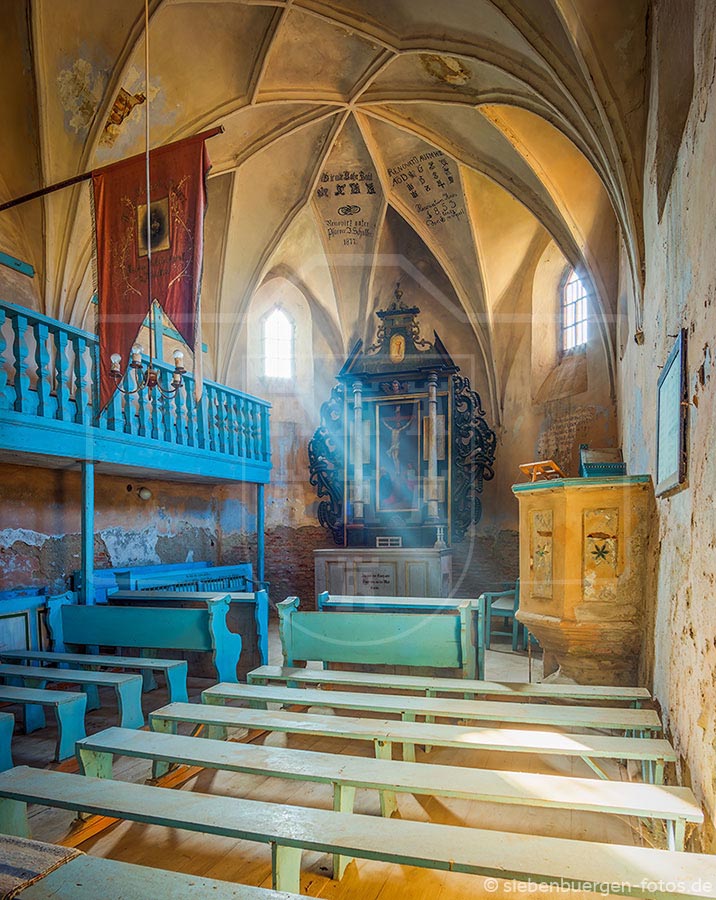
When entering the church, one has the impression that the congregation vanished from one day to the next. Open Bibles lie on the altar and the pulpit, flags and family dedication plaques hang on the walls and from the gallery, and the organ appears to be more or less intact. The bell tower served multiple purposes, functioning as a school and storage room.
Daniel Schuster, an 80-year-old Saxon, has been working for over 20 years to save the tower-less fortified church from decay. Moisture is the main problem. Thanks to him and generous donors, the fortress has been preserved to some extent until today, but further measures are needed: securing the roof structure against birds, clearing and clean-up work, emergency stabilisation of the school building, repair of the wall coping and capping, further surveys. The old school is at risk of collapse, the brickwork at the base of the church is badly weathered, bird droppings are damaging the roof structure, and the ring wall is increasingly deteriorating. With relatively modest financial means, these and further damages can be remedied. (Source: kirchenburgen.org)
Amount needed: 3,500 EUR (for further information and donations, please contact Mr Daniel Schuster at stiftung_agenda2023@yahoo.de)
There is much to discover here — and above all, to save!
Author:
Zîmța Andreea
Date: 08.05.2018
For photos from Bussd, please click: Photos from Bussd