Rothberg
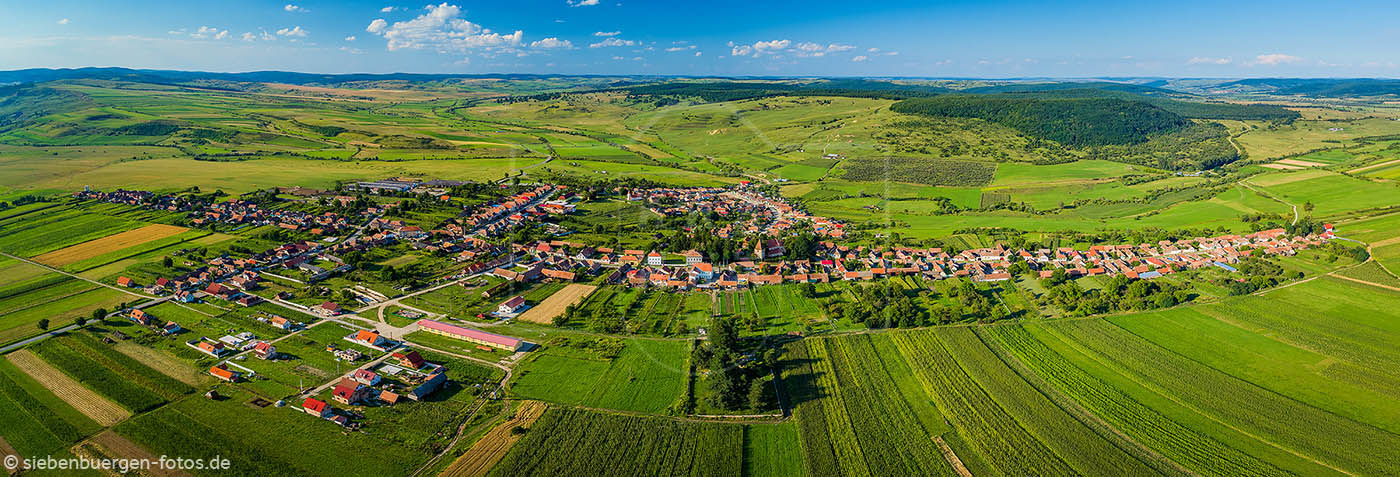
Rothberg (Romanian: Roşia, Hungarian: Veresmart, Transylvanian Saxon: Ruitbrich, also Rudjebich) lies north-east of Hermannstadt (Sibiu). As the village is surrounded by many fields and forests, the local economy is based on agricultural activities such as arable farming (potatoes, grain and vegetables), livestock keeping, timber processing, agricultural trade and tourism. Rothberg was an important stop on the Harbach Valley Railway (a narrow-gauge line popularly known as the "Wusch"), alongside Burgberg (Vurpăr) and Harbachsdorf (Cornățel). In Rothberg you can visit the 13th-century Evangelical church with its impressive defensive tower, the "Hans Spalinger" Waldorf School — which grew out of a literacy project for Roma children — and a burial ground dating from the period of Roman rule in Dacia.
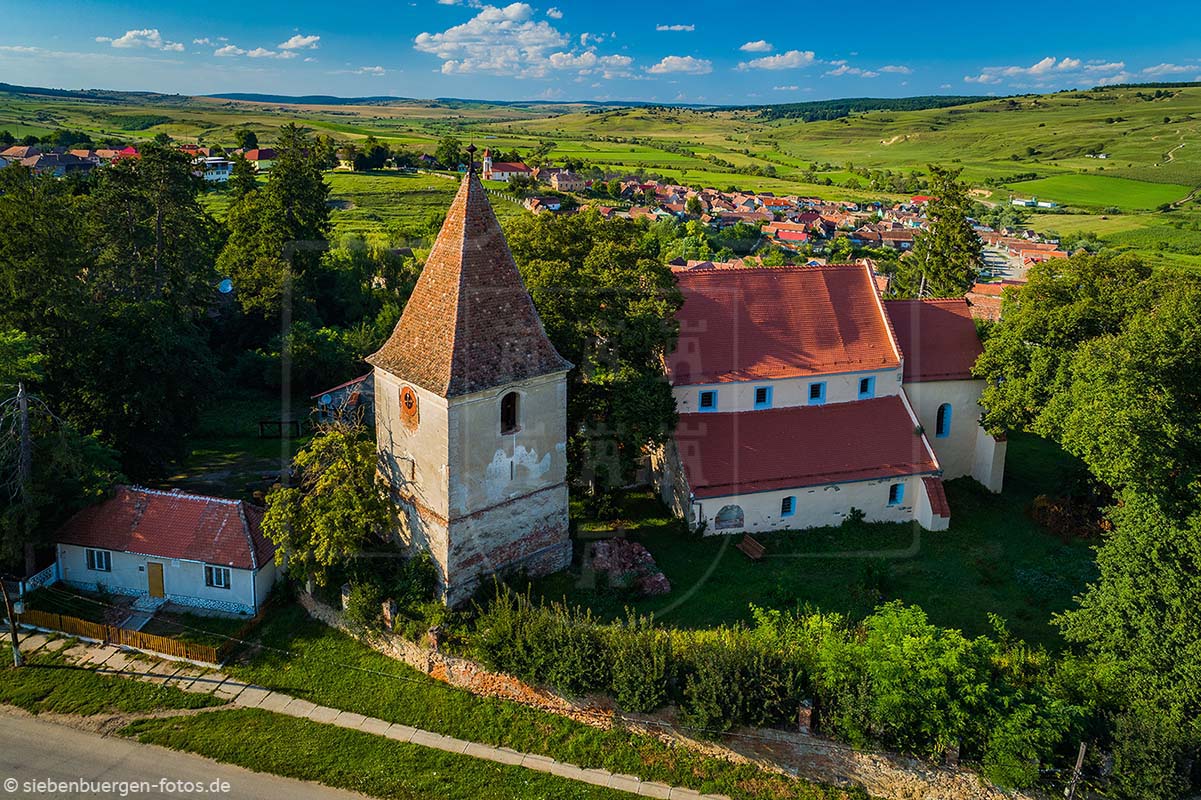
The Rothberg fortified church was built around 1225 as a Romanesque basilica that has remained almost unchanged to this day. The church has three naves and a semicircular chancel. From the original basilica one can still see today the unplastered stone walls, the columns with arches connecting the side aisles to the main nave, the four bays of the vaulted cross-arches of the side aisles, the crossing corners of the chancel, the western façade, the north portal with pilasters, and the traces of windows above the roofs of the side aisles.
Between the 15th and 18th centuries the church was modified by the addition of buttresses, an entrance hall on the western side, enlarged windows, a brick sacristy, and the bricking-up of the north portal. The interior was also altered: the pulpit was embellished with wooden decorations, and a Baroque altar with six Corinthian columns supporting a baldachin with a dome was added. Particularly notable in the church are the traces of a painting in the Neoclassical style and the organ with six registers, which was restored in 2010.
The Evangelical church in Rothberg had a flat roof until 1889, after which it was vaulted, with the central nave spanned by a vault supported on pillars. This church had no bell tower, only a defensive tower, which is still visible. It is 8 metres high, and on the side facing the road there is a clock that unfortunately no longer works. The fortified church survived numerous attacks — for example in the year 1600, when troops of Michael the Brave (Mihai Viteazul) burned the entire village to the ground.
When speaking of Rothberg, one must also speak of Eginald Schlattner. He is a German-Romanian pastor who served as the village pastor until his retirement. He continues to live in the village and works as a prison chaplain for Evangelical prisoners in Romanian prisons. Pastor Schlattner became famous through his three novels "Der geköpfte Hahn" (The Beheaded Rooster), "Rote Handschuhe" (Red Gloves) and "Das Klavier im Nebel" (The Piano in the Fog), in which he recounts his experiences with the Romanian secret service (the Securitate) and the development of Romania since the 1930s.
360° Panorama
Panorama 1Panorama 2Author:
Zîmța Andreea
Date: 21.09.2017
For photos from Rothberg, please click: Photos from Rothberg