Großscheuern
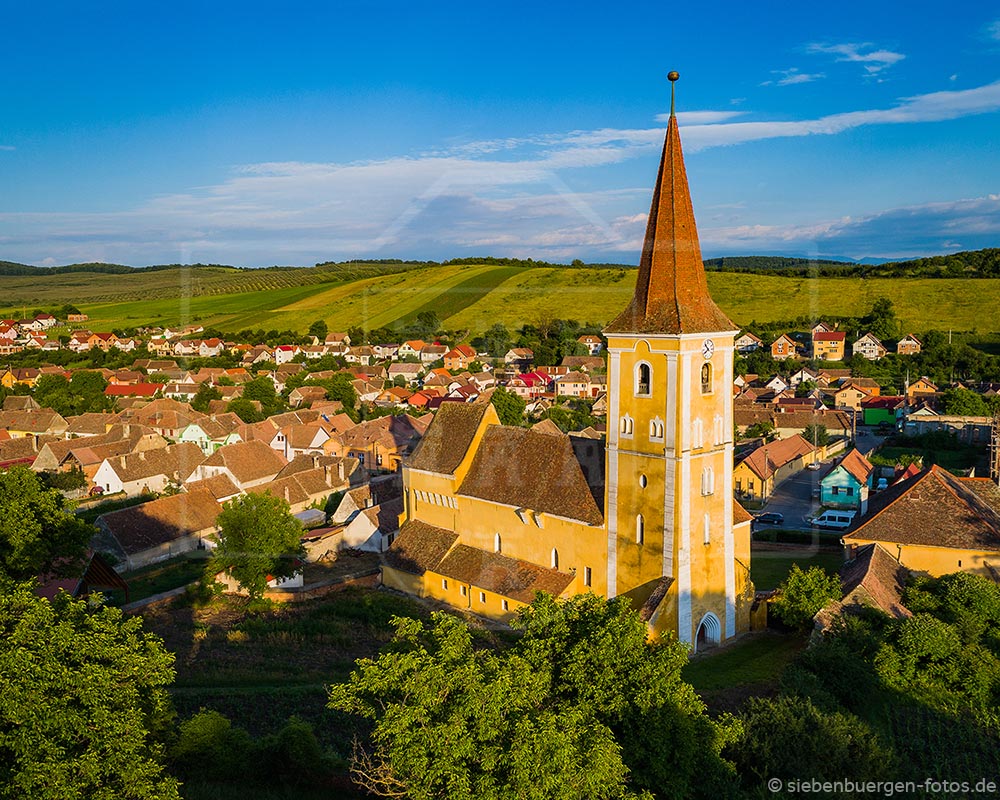
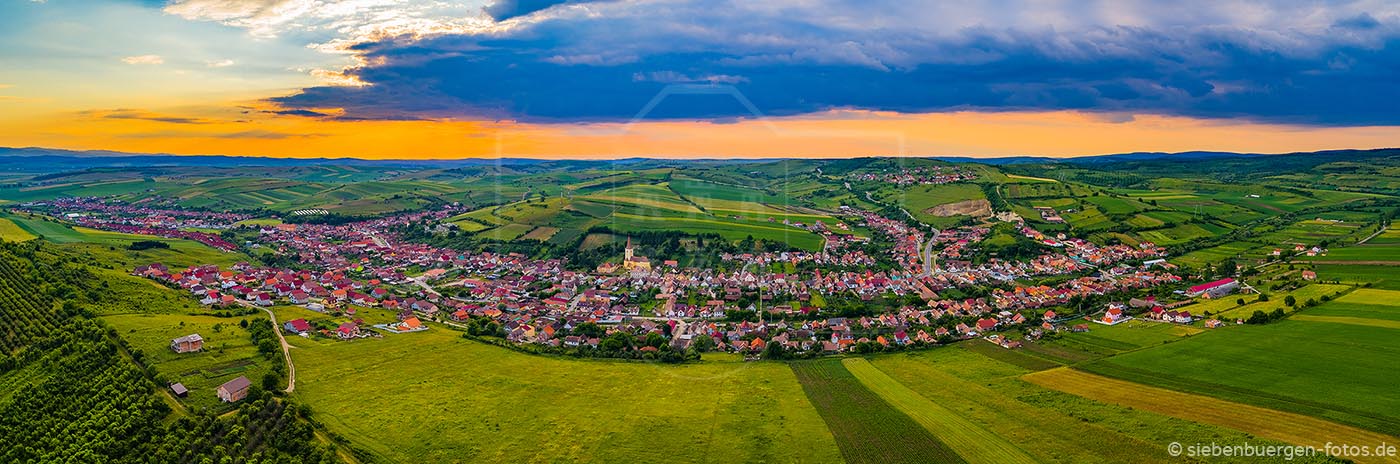
Großscheuern, Romanian Șura Mare, Hungarian Nagycsúr, Transylvanian-Saxon Griissscheiern, is located in Hermannstadt (Sibiu) County in Transylvania, Romania.
The first documentary mention was between the years 1332–1335 under the Latin name Magnum Horreum and later under maior villa Horrei. Until 1493, when Ottoman troops invaded the settlement, it was largely unknown.
The church was built at the end of the 12th century in the old Romanesque style. The central nave had a three-storey bell tower and a flat ceiling. After the Turkish incursions, the bell tower was rebuilt and extended by yet another level. At this time, the Gothic paintings that had adorned the interior of the church were also removed. A few paintings have survived in the northern part of the altar. A section of the west wall and one defensive tower are the only remaining traces of the old fortress still standing today.
The old Catholic church features the same architectural characteristics as those from Großau, Heltau, Neppendorf, Schellenberg and Hammersdorf. It was dedicated to the Virgin Mary.
Construction of the church took a very long time and it was rebuilt several times. Above the choir there is a window bearing an inscription that records the completion of the first reconstruction in 1497. With the fortification of the church in the 15th century, the building was reshaped in the Gothic style, giving it its present form: alongside the choir end built upon the Romanesque apse, there is a net vault in the nave and a ribbed vault in the choir. Two defensive storeys were added above the choir. To fortify the west tower, the side naves at its flanks were replaced by later-demolished turrets. In 1854, the current tower spire replaced one of the defensive storeys. The interior of the church is defined by the colourfully painted galleries. In the side naves there are also painted stalls (1715), brought here from the church in Draas (Drăușeni) — which has been under restoration for years — for safekeeping. (Q. Kirchenburgen.org). The neo-Gothic altar dates from 1903 and the marble-built baptismal font from 1758. The organ was built in 1807 by Melchior Achxs.
Throughout the long history of the village, a number of personalities who had significant influence on the development of Transylvania and Romania have lived and worked in Großscheuern. For example, Friedrich Teutsch served as pastor here between 1896 and 1903, before becoming Bishop of the Transylvanian Saxons three years later and from 1927 Bishop of the Evangelical Church in Romania. In the 17th century, Johann Haupt served seven years as mayor of Großscheuern. Born a poor farmer's son in Großschenk (Cincu), he rose to hold the highest Saxon offices, including that of Hermannstadt Chair judge and Royal Judge. (Q. Kirchenburgen.org)
The Evangelical congregation of Großscheuern, as well as the congregations of Hahnbach, Haschagen, Reussen, Salzburg, Törnen and Wassid, are jointly served from Stolzenburg.
360° Panorama
Panorama 1Panorama 2Panorama 3For photos from Grossscheuern, please click: Photos from Grossscheuern