Großau
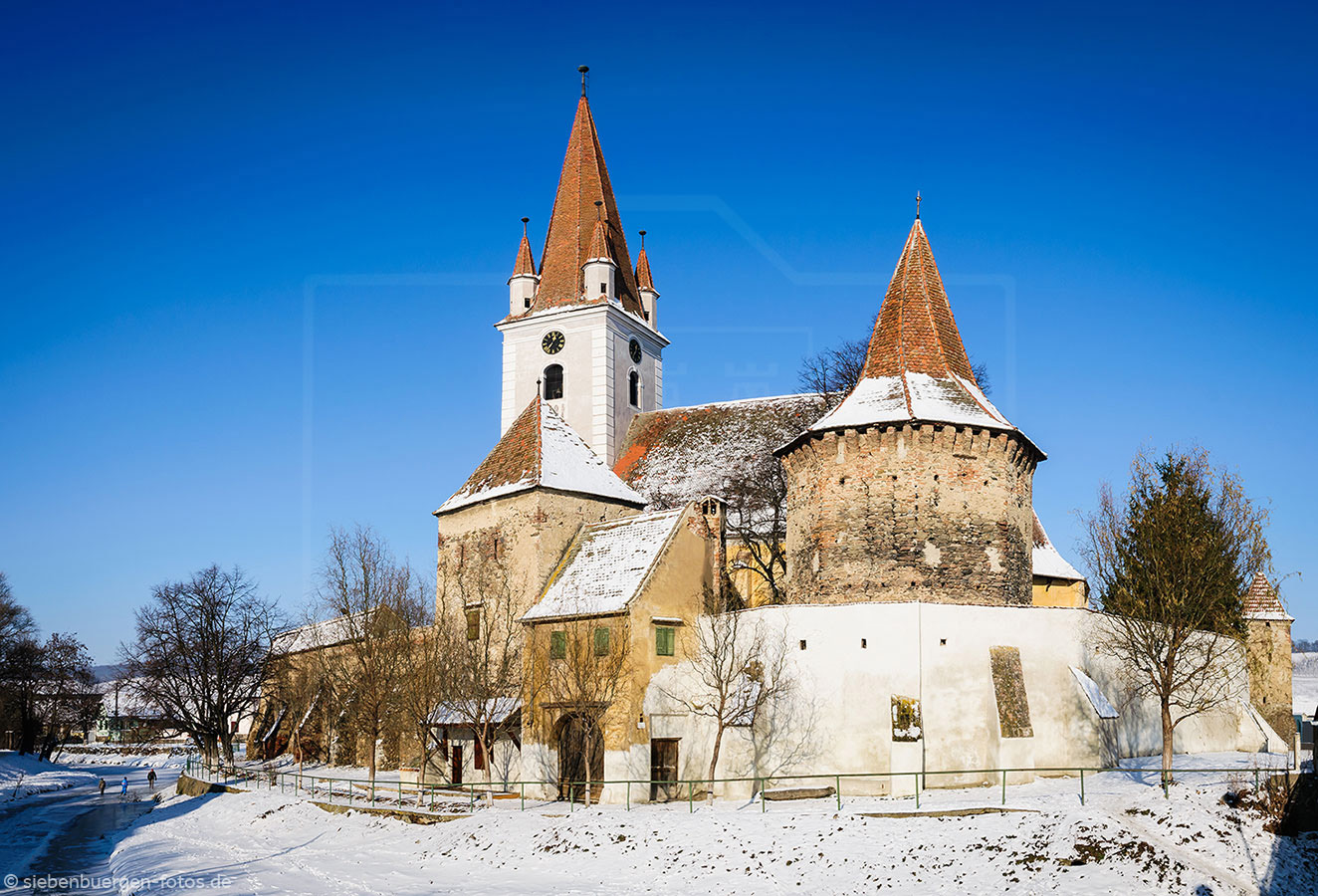
Großau, Romanian Cristian, Hungarian Kereszténysziget, Transylvanian-Saxon Gruusaa*, is located in Hermannstadt (Sibiu) County in Transylvania, Romania.
The first documentary mention dates from 1223 ("insula cristiana"), nearly 100 years after the immigration of the German settlers who were invited to Transylvania by King Géza II. The first Hungarian designation is "Keresztenzygeth" (1395) and the Romanian "Cristianu", first documented in 1787. The German place name appears for the first time in a tax register in 1468. The settlement developed quickly at the gates of Hermannstadt. Großau was the second largest community in the Hermannstadt Chair after Heltau.
From the mid-17th century, a decisive event is recorded: a large Turkish army marching from Hermannstadt to Weißenburg (Alba Iulia) was persuaded by a nobleman to pass by the fortified church of Großau without fighting. However, after a drunken Großau resident shot at the troops, they stormed the fortified church. The attackers nevertheless failed to take the church tower, in which the villagers had barricaded themselves. They therefore set fire to wood and straw at its base and suffocated the defenders. Afterwards the entire community was burned down. (Q. Kirchenburgen.org)
Großau, together with Großpold and Neppendorf, is one of the three communities in which Protestant Landlers, expelled from the Salzkammergut and Carinthia since the 18th century, have lived.
Construction of the fortified church began in 1250 with the building of a Romanesque basilica that reached as far as the present-day choir. At the end of the 13th century the church was surrounded by palisades, and after the middle of the 14th century the old basilica was replaced by a hall building. The master builder Andreas Lapicida was commissioned for this complex work. The construction had to be interrupted at the time as the settlement was attacked by the Turks. Thus the first inner ring wall was created. Over time the three-aisled pier basilica (dedicated to Saint Servatius) was rebuilt several times. Despite the changes, the lower part of the Romanesque bell tower, column remnants of the northern side nave, a small tower of the wall of the western part of the southern side nave, and inside the church a pier cap of the first arcade arch were preserved. The old gate tower was undermined by the adjacent river and later replaced by a new one.
Around 1500, two forecourts were added to the north of the fortified church. A double wall separated them from each other. The rectory was built in the first forecourt. Since the village had lost much of its former strength in subsequent centuries (reflected in the dramatically declining population figures: over 800 inhabitants in 1488, still 450 in 1536 and even only 320 in 1712), the fortified church was repeatedly taken by enemies. So in 1599 by the troops of the Wallachian prince Mihai Viteazul and in September 1658 by the Tatars. And yet attempts were always made to maintain the defensive capability of the fortress. As late as 1731, part of the ring wall was newly built. This is recalled by a keystone with a head of Christ worked into the southern outer wall, bearing the inscription: "Ano 1731 D. 25. April". — (Q. Josef Vetro).
The interior furnishings of the church are distinguished particularly by the lavishly decorated Baroque altar of 1729 and by the organ, which was rebuilt several times.
In modern times, the listed fortified church and the surrounding village are occupied every year from above: several pairs of storks build their nests here and raise around 80 young storks every year.
Even after the emigration wave of the early 1990s, the Großau congregation still exists, though with a greatly reduced membership. Originally the Großau congregation was an independent congregation subordinated to the district consistory of Hermannstadt. Together with the districts of Schäßburg, Kronstadt, Mediasch and Mühlbach they form the Evangelical Church A.B. in Romania (led by Bishop Reinhard Guib). Due to low membership numbers, the Großau congregation is no longer independent. It has merged into a community association with the congregations of Neppendorf, Hamlesch, Reußdörfchen and Kleinscheuern. The responsible pastor is former dean Heinz-Dietrich Galter.
In Großau there are no official street names in the classical sense. The lanes are numbered with Roman numerals. In the Saxon dialect, however, the streets did indeed have names such as Kirchgasse (Church Lane), Klättittengässchen (meaning Pancake Lane), etc.
Großau has a long but wonderful history. It is best to have this history told to you on site.
Further information can be found at www.grossau.de. The Großau Homeland Community is very actively involved in community life and the Großau residents have made great efforts to document their entire history.
For photos from Grossau, please click: Photos from Grossau