Groß-Schenk
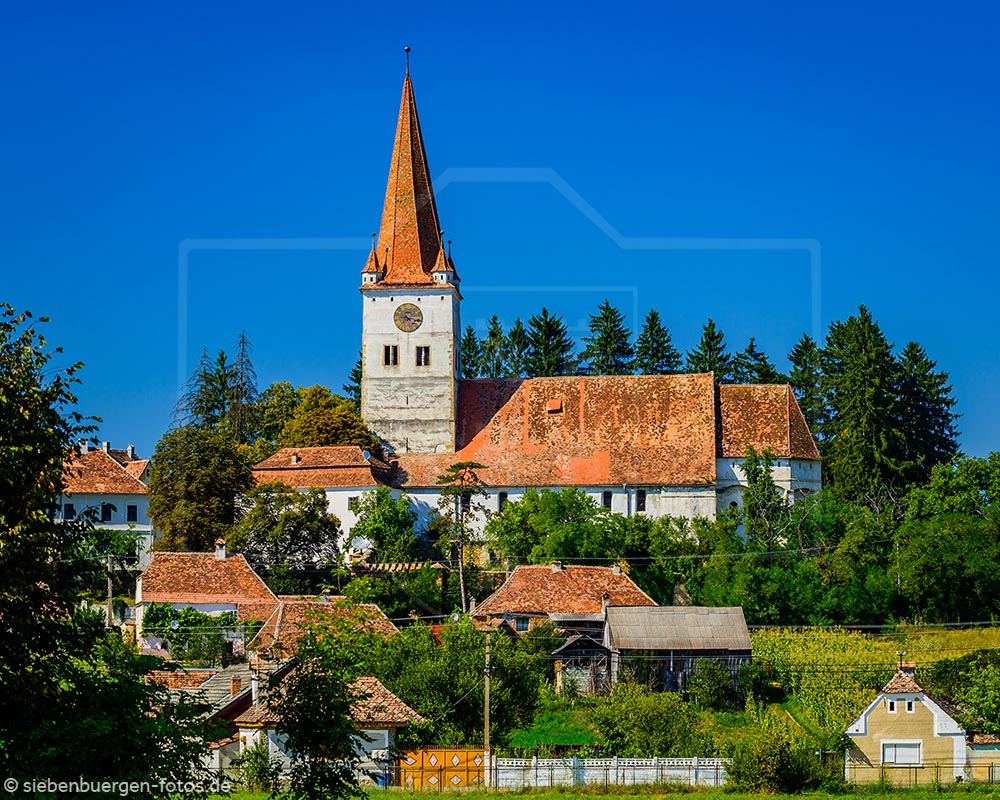
Großschenk, Romanian Cincu, Hungarian Nagysink, Transylvanian-Saxon Gruissschoingk, is located in Brașov County in Transylvania, Romania.
The settlement was founded in the mid-12th century by Saxon colonists on a plateau between the rivers Olt and Harbach. The first documentary mention dates to 1329. Within a short time, the then small settlement became the seat of the Großschenk Chair.
Where exactly the inn stood at the end of the 12th century — the inn that gave the place its current name — cannot be said with certainty. It may have been built by one of the counts of Großschenk along a former military road. The counts, who were among the most important figures of the settlement in the past, served as advisors to their community and to the lord of the land, held the office of judge, and in times of war led the settlers. An anecdote has been handed down from the early days of Großschenk: In times when the borders had not yet been definitively drawn, a dispute arose over the ownership of a piece of land. During negotiations to clarify ownership rights, held directly on the contested field, the elder of Großschenk swore: "I stand on Großschenk soil!" This was technically true, as he had filled his boots with soil from home before leaving. On the way back, his horse is said to have stumbled at the so-called "Evil Bridge" and broken its neck. (Kirchenburgen.org)
Many historians believe that the fortified church in Großschenk was a unique basilica in Transylvania, because its defenses were only on the western side. It stands on a hill that drops steeply on three sides.
The church was built in the 13th century and was dedicated to the Virgin Mary and Saint Paul. Between the 16th and 18th centuries it was rebuilt several times.
The first documentary mention is found in a privilege granted by Matthias Corvinus in 1474 to the defenders of the fortress.
Originally the church had three naves of unequal size. Over time these were altered so that all were brought to the same level. The side naves are each 38 metres long and border the west tower (13th century) on both sides, being about 10 metres longer than the central nave. The bell tower is on the west side of the church and was restored after a fire, resulting in a change in the size of the central nave relative to the sides. The organ gallery is also located there.
In the 18th century the fortifications were demolished and the church received its current characteristic tower spire. A large part of the two ring walls, equipped with bastions and defensive towers, was torn down. However, the so-called old town hall and a defensive granary have been preserved from the former fortified buildings. The interior today has the appearance of a hall church, after the side naves were raised in 1693 to accommodate galleries.
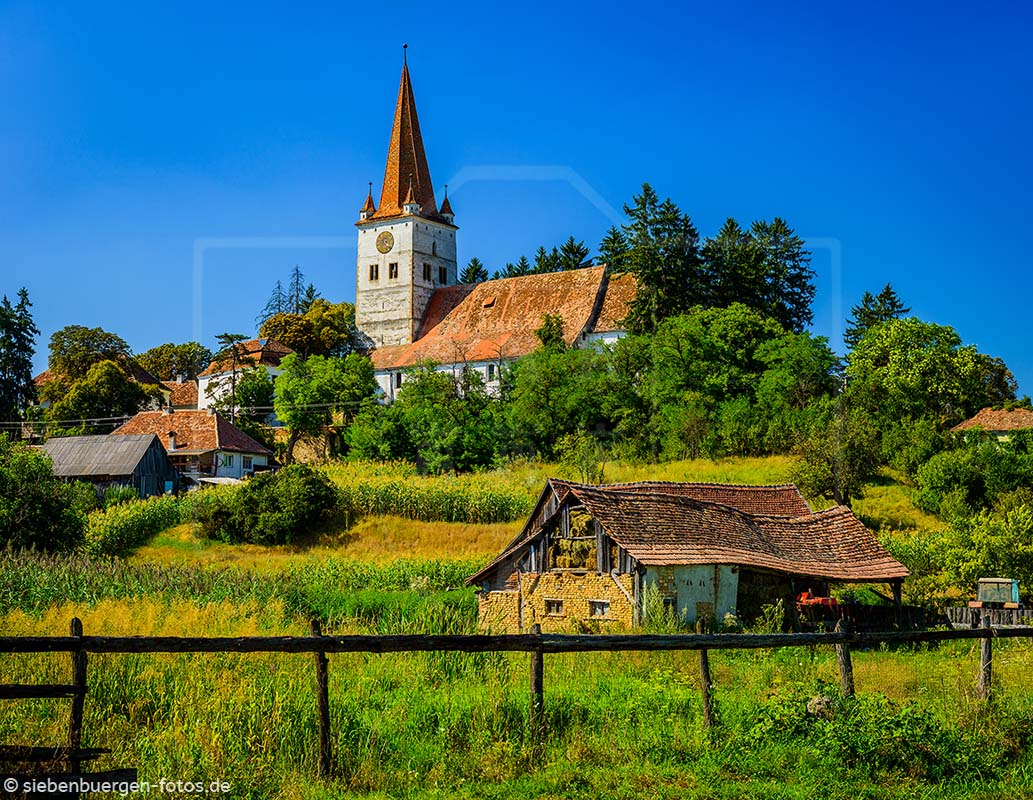
As one of the most valuable monuments of medieval architecture in Transylvania, the church houses a number of valuable collections: a collection of oriental carpets (17th to 18th century), collections of emblems and traces of various guilds and companies, collections of wall paintings, Gothic choir stalls, a chalice from the 15th century and a clockwork from the 19th century.
The most important element of the church is the altar, which depicts the disbelief of the Apostle Thomas. The altar features an altar stone on which the words of Jesus to Thomas are inscribed. Originally the altar was built for the church in Meschen, but it was later purchased by the people of Großschenk and painted by a master from Hermannstadt who was famous at the time. The church presents a series of archaic elements that have helped specialists date its construction (1265). These elements are often found in Roman basilicas built at the beginning of the 13th century. More precise dating could be achieved through the wall frescoes, but unfortunately these could no longer be restored. By analysing the building materials, the various phases of transformation of the church as well as the appearance or renovation of certain architectural elements could be determined.
A special feature of the fortified church is the tower, which according to many visitors closely resembles the tower of the Heltau church Heltau
In recent times, Großschenk has become known for the American shooting range. The Evangelical congregation of Schenk consists of the communities of Großschenk and Kleinschenk. In total, more than a hundred souls live in the congregation, which was once the seat of its own church district.
Currently the Schenk congregation is also served from Freck.
For photos from Gross-schenk, please click: Photos from Gross-schenk