Elisabethstadt
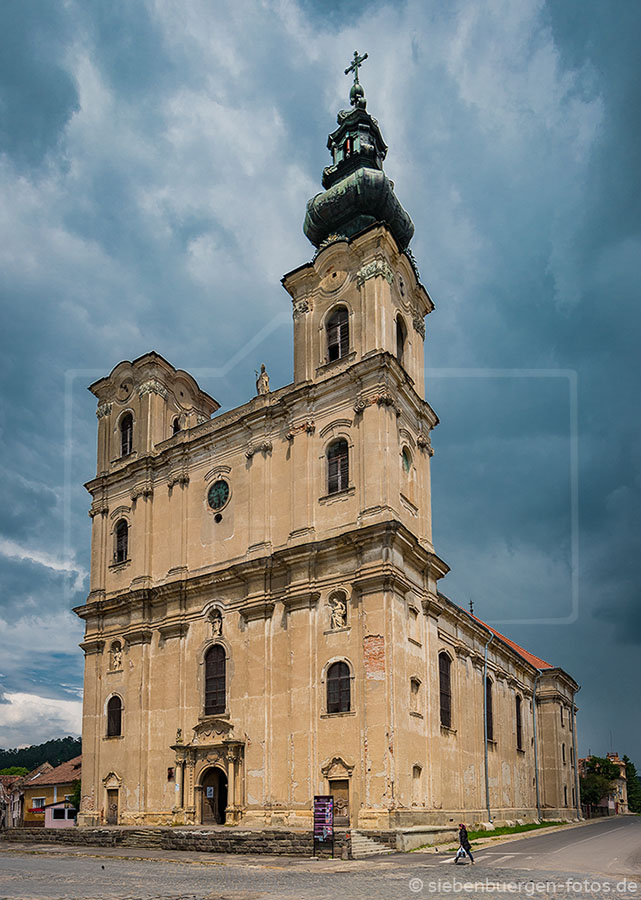
Elisabethstadt (Romanian: Dumbrăveni, Hungarian: Erzsébetváros, Transylvanian Saxon: Eppeschderf) lies in Hermannstadt (Sibiu) County in Transylvania, Romania.
This small town has a long multicultural history. Over time, Romanians, Hungarians, Saxons, and Armenians all lived here.
The settlement was founded in the 13th century by Transylvanian Saxons and first mentioned in writing in 1332. Archaeological finds in the area of the incorporated village of Șaroș pe Târnave indicate human settlement of the region going back to the Early Bronze Age.
In the 15th century the area was dominated by the influential families Bethlen, Fejérdi, and Apafi. Grigore Apafi purchased all the houses in the village in 1552 and built a Renaissance-style castle. In 1661 Michael I Apafi became Prince of Transylvania. As a result, the then-named Eppeschdorf became a temporary princely residence.
Two events were particularly significant for the town's history. In 1773 the settlement was visited by Emperor Joseph II, who was accommodated in the house of an Armenian. As a result of the royal visit, a commemorative plaque bearing the inscription "Benedictus Iosephus II Imperator Augustus atque Pius Rex Paterpatriae nos hoc anno 1773 in Junio visitavit" was attached to the house. After 1989 the plaque disappeared and the house was converted into a grocery store.
The second significant event was the settlement (1671–1685) of Armenians expelled from Moldavia. As merchants they received numerous privileges. They eventually acquired the castle and also settled in surrounding villages, such as Halvelagen (Hoghilag), Ehrgang (Ernea), and Scharosch (Șaroș pe Târnave). In the 18th century they built the Armenian cathedral in the Baroque style, which today is among the most beautiful cathedrals in the country. The church looks unusual because it lacks the dome of a tower that was toppled by a powerful storm in 1927. An important figure for the settlement was Avedik Likacs, a local priest who in 1896 published the first monograph of Elisabethstadt in the Hungarian language.
In the 18th century Eppeschdorf was renamed Elisabethstadt and was granted the status of a privileged town. Gradually the Armenians adopted the Hungarian language and culture.
Since the end of the First World War the town has belonged to Romania. Together with Gherla (Armenierstadt / Armenian Town), Dumbrăveni is one of the historically significant Armenian towns in Transylvania.
The Evangelical congregation of Elisabethstadt has just under seventy members. The congregation, situated on the Great Târnava River, is today administered from Mediasch (Mediaș).
For photos from Elisabethstadt, please click: Photos from Elisabethstadt