Alzen
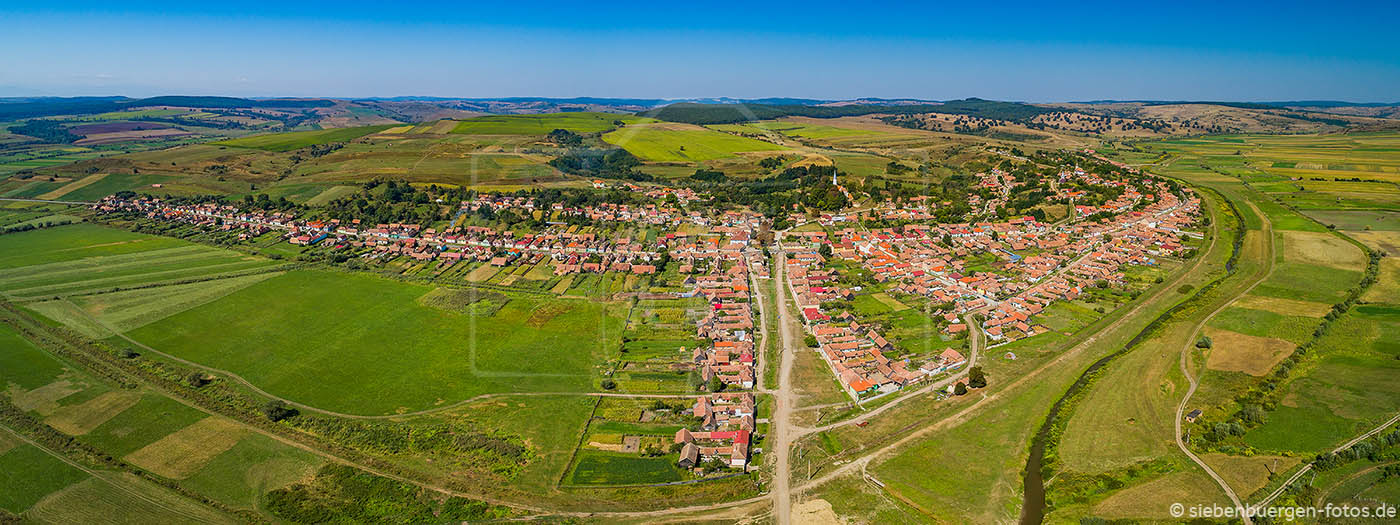
In the river basin of the Harbach, in Transylvania, lies Alzen (Romanian: Alțîna, Hungarian: Alczina / Alcina, Transylvanian Saxon: Ålzen). The village has a long history and is shaped by many legends.
One of the best-known legends concerns a mysterious mill that is said to have vanished on New Year's Eve. The villagers heard terrible ringing sounds during the night from the attic and from the water. The last miller responsible for the mill fled that same night in terror. The next day the mill had disappeared without a trace. The only reminders of the old mill are the name of the stream "Alt-Mühlgraben" (Old Mill Channel) and the field beyond the stream, called "Bei der alten Mühle" (By the Old Mill). (Source: kirchenburgen.org)
Another legend says that the first Saxons who arrived in this area were led by ten counts. Each wanted the place to bear the name of his own count, which was impossible. So they decided the name would be "All Zehnn" (all ten).
Alzen is first mentioned in written records in 1291 under the name "Olochna", in a land sale to counts Gerlach and Stefan of Alzen. For centuries Alzen was ruled by this comital family. The commune was one of the largest Saxon communes of the Leschkirch (Nocrich) chair. For centuries Alzen and Leschkirch competed for the administrative centre. Only temporarily did the Alzen count Jakob Gerendi manage to hold the royal judgeship of Leschkirch. He ultimately had to yield to the defensive power of the Hermannstadt (Sibiu) province. Since the mid-15th century the noble court of the Gerendi family was located in Alzen. The commune succeeded in 1593 in buying out the Gerendi estate and thereby gaining its freedom. (Source: HOG Alzen)
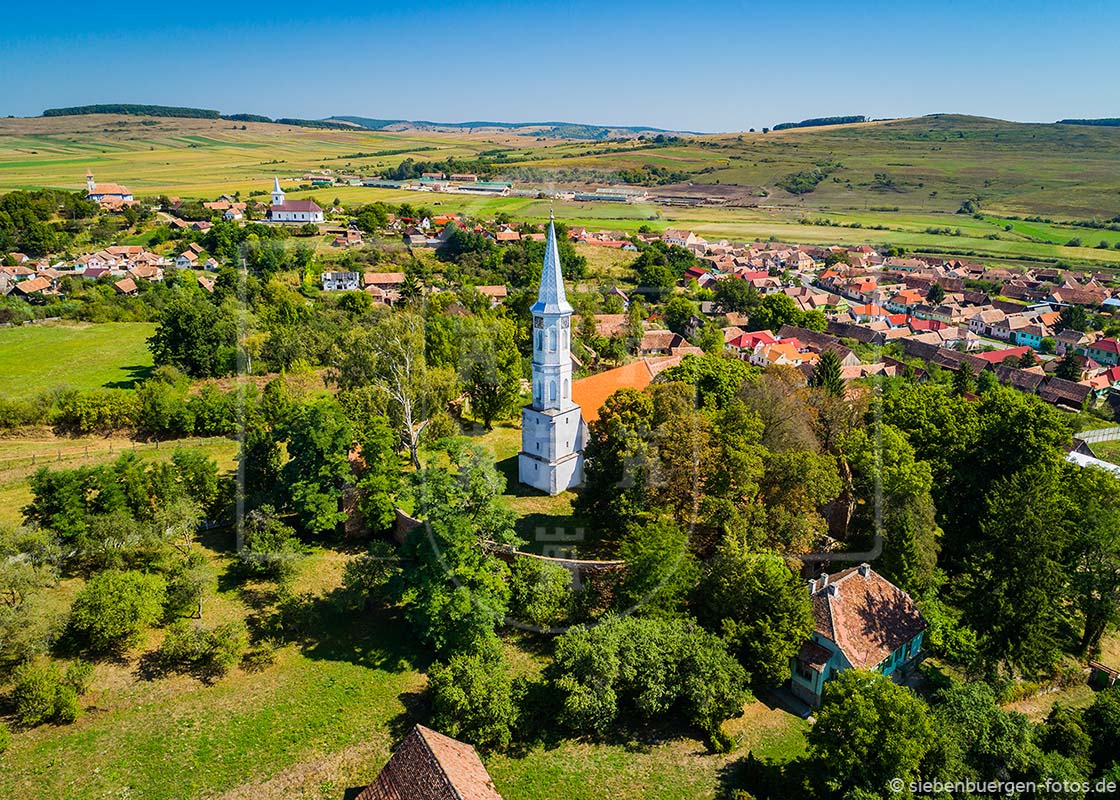
Watching over the commune and the village is the old fortified church. The Romanesque basilica from the 13th century was converted into a defensive structure. The chancel was later extended and the southern aisle received a Baroque vault. In the mid-19th century the bell tower was added to the western nave and the sacristy was added to the chancel on the south side.
The church was subsequently reinforced with an oval outer wall and provided with defensive towers.
The most valuable possession of the church is the baptismal font (1404), cast from bell bronze by the Hermannstadt master Leonhardus.
When visiting Alzen, one should take the time to visit the inter-ethnic museum. It is a special museum housing an extensive collection of Romanian, Saxon, and Hungarian cultural objects.
Author:
Zîmța Andreea
Date: 12.04.2018
For photos from Alzen, please click: Photos from Alzen