Almen
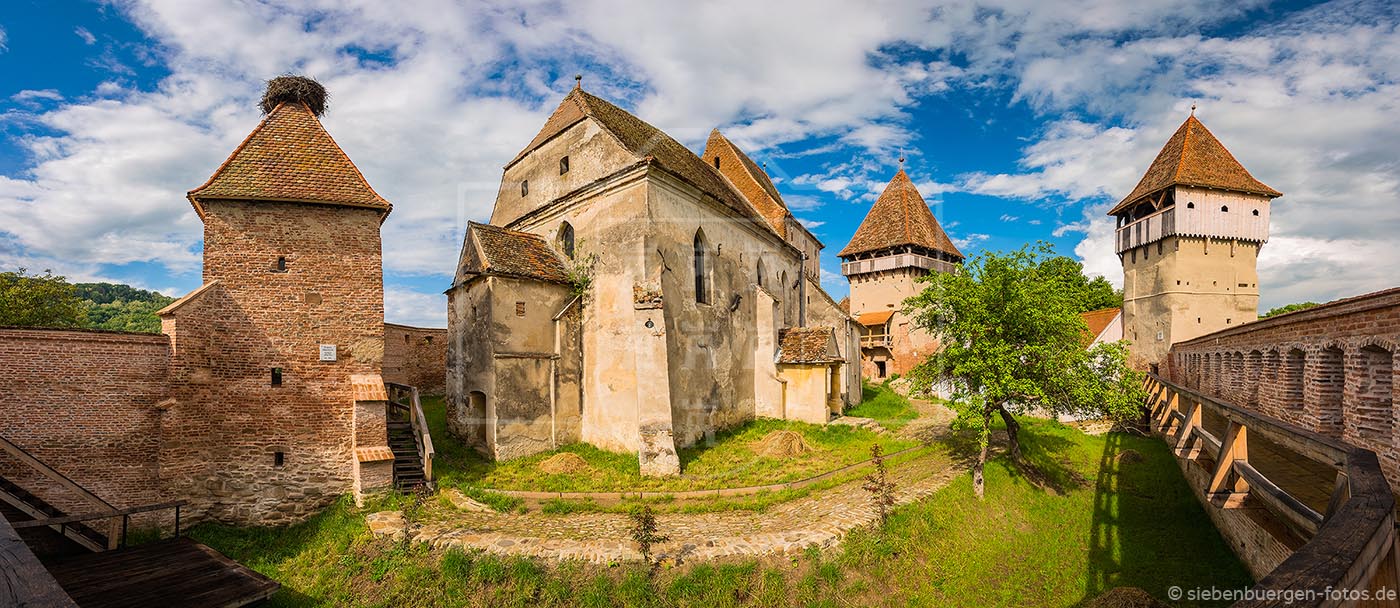
At the end of a country road between hills covered with dense forests lies Almen (Romanian: Alma Vii, Hungarian: Szász-almád, Transylvanian Saxon: Ålmen).
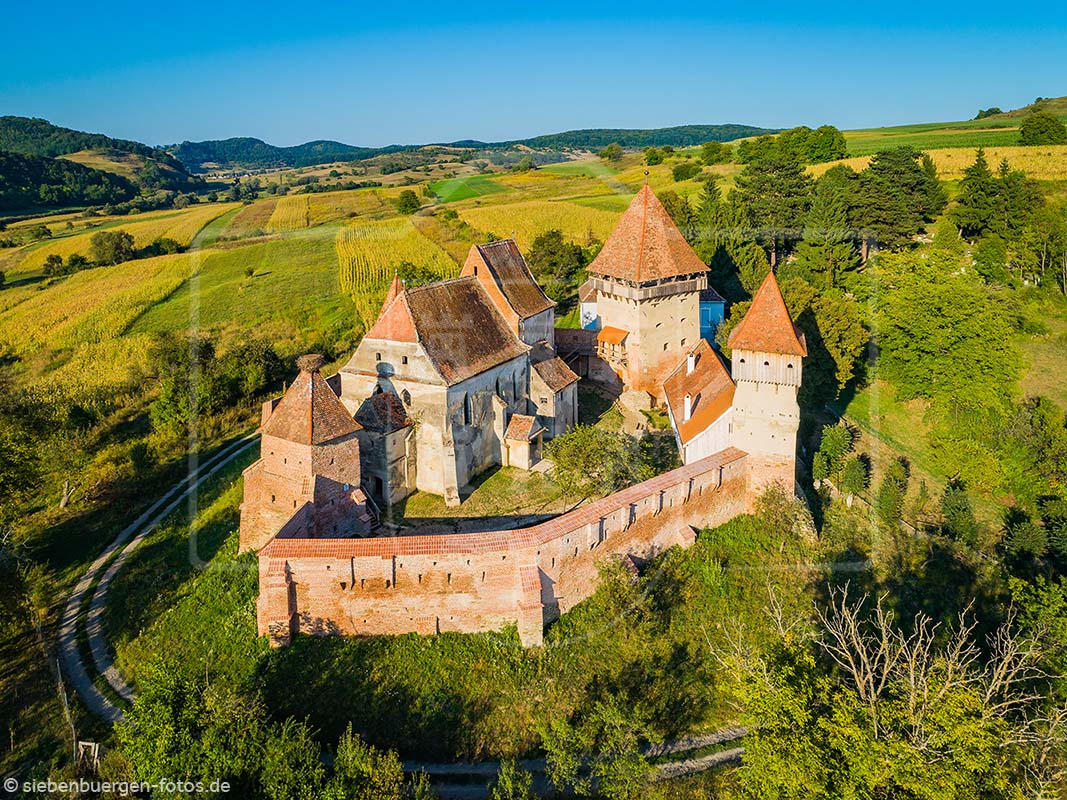
The fortified church on the hill rises above the traditional houses like a vision from a medieval tapestry or a fairy tale. The centuries-old Saxon fortification is the most important element in the plan to create a world-class model of sustainable local and regional development here. The Mihai Eminescu Trust (MET) is responsible for implementing this plan in the village. Together with international partners, a "Centre for the Interpretation of Traditional Culture Almen" is currently being developed.
When visiting Almen, one immediately senses a certain connection between the fortified church and the village. For the local people, the Saxons have not disappeared — they are not a long-lost civilisation left behind somewhere. They live on, still present as an ideal in the souls and minds of the people.
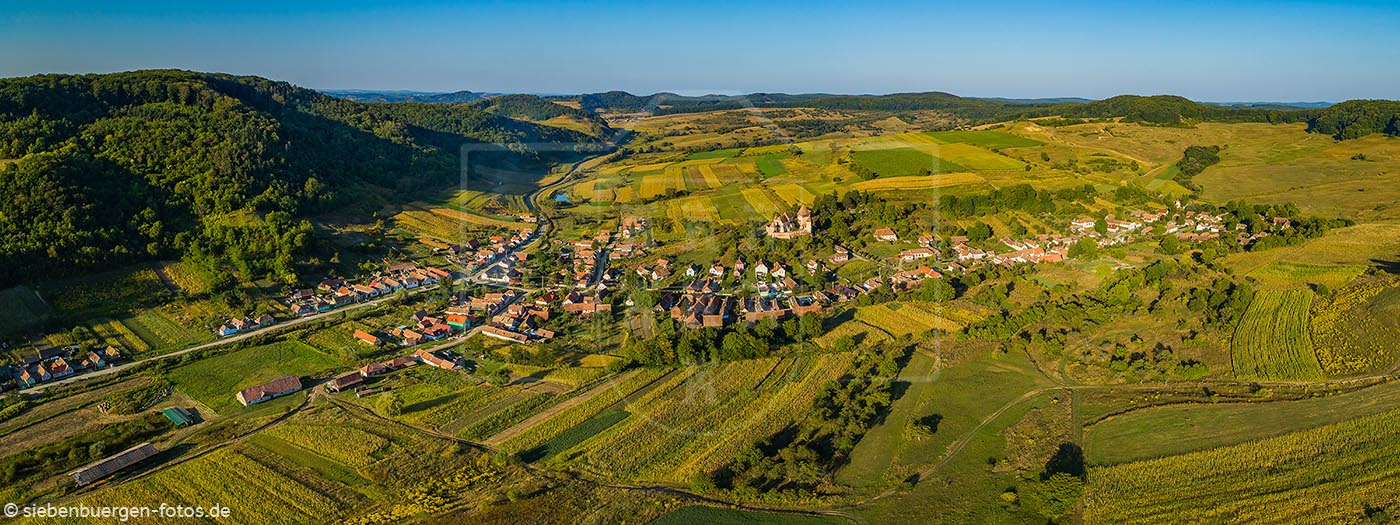
The people of Almen are known for their fruit growing. For centuries, the villagers have cultivated orchards in and around Almen. Some believe the village name derives from the Hungarian word for apples. (Source: Kirchenburgen.org)
Much can be said about the mighty fortified church. Most importantly, it was never conquered. According to legend, this is thanks to the castle guardian Alma. From afar she spotted a horde of Tatars. To distract them and give the villagers time to flee into the fortress, she dressed in dirty rags, smeared her face with coal and jam, and ran out to meet the Tatars. Before them she performed witch-like dances. The Tatars were frightened and turned back.
To protect themselves from the many attacks, the villagers reinforced the hall church, which dates from the first half of the 14th century. Two additional storeys were built over the chancel, with the upper storey corbelled out on profiled brackets between which drop holes were left open.
Inside the church there is a classicist altar from 1852 with a painting of Christ, flanked by four Corinthian columns. The baptismal font and pulpit were also built in the classicist style. The organ dates from 1791, has 11 stops, and was made by Andreas Eithel from Brașov (Kronstadt).
The fortified church slopes downward to the south-west towards the village. To the south stands the five-storey bell tower, which has gun embrasures in the fourth storey. The towers to the north and west have three storeys and are covered with pyramid roofs. The ground-floor passage of the eastern gate tower (17th century) was protected by a portcullis, whose sliding grooves are still preserved. The ring wall was erected at the end of the 15th century.
Each tower houses exhibitions of traditional Transylvanian Saxon objects. Since 2009 the Mihai Eminescu Trust (MET) has been active in Almen, carrying out various projects to restore the fortified church and promote general village development. (Source: Kirchenburgen.org)
Author:
Zîmța Andreea
Date: 16.04.2018
For photos from Almen, please click: Photos from Almen